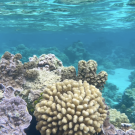
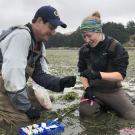
UC Davis Chancellor Gary May interviewed Rachael Bay as part of his series, Face to Face. Chancellor May learned about corals, climate change, getting undergrads into research in genomics, and a bit of what it's like to be one of Popular Science magazine's "Brilliant 10."
We're thrilled to announce that the 2023 cohort of Sloan Research Fellows includes Professor Kate Laskowski. The Sloan Research Fellowship, a prestigious award given by the Alfred P. Sloan Foundation, recognizes early-career scientific researchers seen as emerging leaders in their fields.
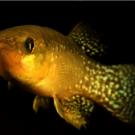
UC Davis environmental toxicologist Andrew Whitehead recently was interviewed by The Conversation Weekly. The podcast described three case studies, including Andrew's work, that demonstrate how humans can drive rapid evolution in natural systems. Andrew's research documents populations of killifish that thrive in polluted estuaries. But rather than a source of optimism, Andrew describes this as a "cautionary tale."
Bumble bees are some of the world’s most important pollinators, yet many bumble bee species are in decline. Our understanding of how landscape changes affect bumble bees is often limited to studies of where they forage on flowers. Through this project, REU students will test how bumble bees use landscapes throughout their life cycles. Students will compare the behavior and abundance of bumble bees across habitat types. We hypothesize that bees use different habitat types for nesting vs.
Urban flower gardens are growing in popularity, and have the potential to contribute significantly to pollinator habitat. However, it is unknown whether these gardens provide a safe haven for declining populations or create low quality habitat that contributes little to conservation. Monarch butterflies are abundant in urban gardens in the San Francisco Bay Area. One concern is that monarch caterpillars in cities experience increased risk of predation by human-associated animals such as paper wasps and yellow jackets.
Jay Stachowicz' research recently was featured by the UC Davis College of Biological Sciences. Stachowicz is part of a global network that studies seagrasses and the organisms that live in coastal seagrass beds. They found that genetics influences on seagrasses dating back to Pleistocene glaciation have influenced the genetic diversity, size, and community structure of seagrasses even more than current conditions.